
Green Pest Control & Pesticide-Residue-Free Cultivation of Gulong Star Anise in Teng County, Guangxi
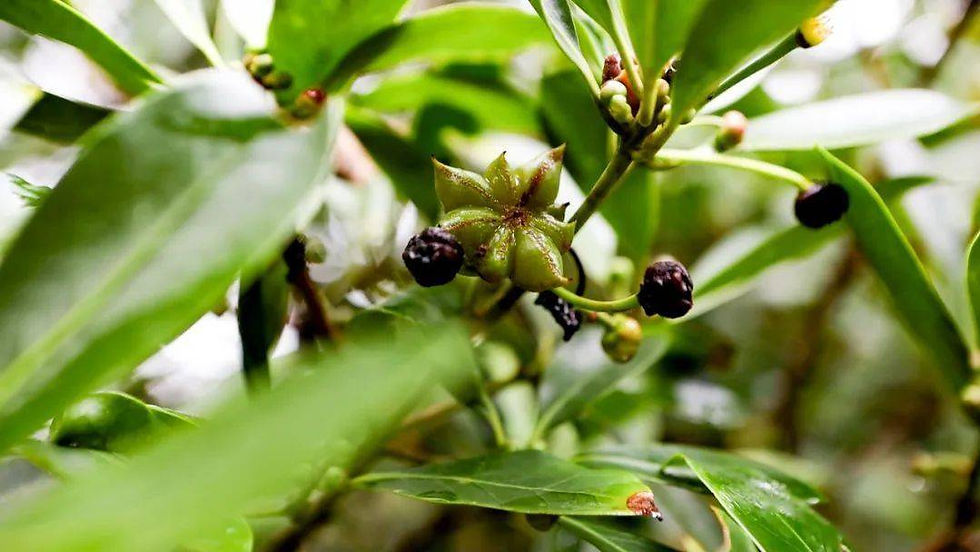
As the "Hometown of Star Anise in China" and the core star anise producing area of Teng County, Gulong Town boasts over 260,000 mu of soft-branch big red star anise forests with a planting history of more than 100 years. Star anise anthracnose, star anise looper, sooty mold and leaf beetles constantly threaten forest health, with pests and diseases affecting about 30,000 mu of woodlands every year. Mild disasters cause flower and fruit drop, cutting yields by 10%-15%, while severe cases lead to weakened tree vigor and degraded fruit quality. As a geographical indication medicinal and edible crop, Gulong star anise supplies domestic braising seasoning and herbal medicine markets, and exports to Southeast Asia. Excessive pesticide residues will directly weaken its brand premium and disqualify it from export inspections. Local governments, agricultural science and technology specialists, and deep-processing enterprises including Guangxi Deng’s Spices have collaborated to build a green prevention and control model prioritizing ecological prevention, dominated by physical and biological solutions and restricting chemical pesticides. A full-standard pesticide-residue-free cultivation scheme has been formed to achieve dual goals of stable yield, quality improvement and green safety for Gulong star anise.

I. Occurrence Rules of Major Star Anise Pests & Diseases and Industrial Pain Points in Gulong
1. Core Diseases of Gulong star anise
Star Anise Anthracnose: The most prevalent fungal disease in local orchards. It breaks out heavily during new shoot growth from March to April and high-temperature rainy seasons from July to September, especially in low-lying and densely planted woodlands. It infects young leaves, fruits and tender branches, triggering black leaf spots and massive fruit shedding, turning dried star anise black and downgrading its quality.
Sooty Mold: Propagates alongside aphids and scale insects from April to October. A black mold layer covers leaf surfaces to block photosynthesis, sharply reducing the oil yield and natural aroma of Gulong star anise.
2. Major Pests Threatening pesticide residue free star anise
Star Anise Looper: The top leaf-eating pest in Teng County Gulong star anise plantations, breeding multiple generations annually with peak damage in April-May and September-October. Larvae can devour all leaves of a single tree, draining tree nutrients and triggering drastic yield cuts in the following year. Larvae hang down via silk when disturbed, making traditional manual elimination highly labor-intensive.
Star Anise Leaf Beetle & Shield Bugs: They gnaw young spring shoots and inhibit flower bud differentiation, causing high mortality among young star anise trees.
3. Prominent Drawbacks of Conventional Star Anise Planting
Scattered mountain land and tall star anise trees hinder mechanized pesticide spraying. In the past, farmers overused highly toxic chemical pesticides, bringing risks of excessive pesticide residues that fail inspection standards for herbal medicine and exported spices.
Over-reliance on chemical agents breeds pesticide resistance in pests and diseases, forcing increased pesticide dosage year by year and creating a vicious cycle incompatible with organic star anise cultivation.
Overcrowded forests lack ventilation and sunlight, while low soil organic matter weakens star anise trees’ natural stress resistance, leading to repeated outbreaks of pests and diseases.
No supporting residue control during harvesting and drying; unregulated sulfur fumigation and incomplete cleaning further aggravate food safety risks for star anise deep processing raw materials.
II. Foundation of Pesticide-Residue-Free Cultivation: Fitness Cultivation to Cut Pest & Disease Sources From the Root
Gulong implements an ecological cultivation system of "nurture trees first, prevent diseases later". It improves woodland microenvironments to strengthen star anise trees’ natural resistance against pests and diseases, minimizing pesticide usage at the source — the core foundation for pesticide-residue free star anise.
Standardized Pruning & Canopy Shaping to Optimize Forest Microclimate
Agricultural specialists promote dwarf grafting technology to renovate low-yield aging forests over 30 years old; trees are topped to lower height for easier orchard management. After annual fruit harvest, diseased branches, dead branches and overcrowded crossing branches are trimmed intensively. Sparse thinning keeps woodlands ventilated and sunlit, eliminating the humid breeding ground for anthracnose and sooty mold. Fallen diseased leaves on the ground are collected, deeply buried and decomposed to eliminate overwintering pests and pathogens.
Organic Fertilizer Improves Soil, Single Quick-Acting Chemical Fertilizers Banned
Urea and high-nitrogen compound fertilizers are completely prohibited. A local compost system is established: star anise branches, fallen leaves, weeds, peanut meal and decomposed cattle & sheep manure are fermented with EM microbial agents as base fertilizer. Organic water-soluble fertilizer and biogas liquid are used for topdressing, supplemented with boron, potassium and medium trace elements to balance nutrients and boost tree disease resistance. Native low-growing nectar weeds are retained in woodlands without herbicides, preserving habitats for natural predators including ladybugs and parasitic wasps — a key measure of Chinese star anise green planting.
Scientific Water Management & Zoned Woodland Supervision
Drainage ditches are dug in low-lying waterlogged plots to avoid root rot induced fungal diseases. Only unpolluted mountain spring water is used for irrigation, with regular water quality monitoring to prevent heavy metal contamination. Zoned segmented management is adopted for young orchards, full-bearing orchards and aging orchards with unified pest & disease monitoring schedules.
Improved Seed Varieties for Innate Disease Resistance
High-quality local soft-branch star anise varieties are popularized. Supported by Guangxi Academy of Agricultural Sciences, a superior seed breeding base is built in Gulong, with graft renovation completed on 50,000 mu of old forests. Improved varieties feature far stronger tolerance to anthracnose and loopers than seedling trees, reducing disease breakout frequency for Teng County Gulong star anise.

III. Full-Cycle Green Pest & Disease Control Technology (Zero Highly Toxic Pesticides, Strict Residue Control)
Following the integrated pest management (IPM) principle of "prevention first, comprehensive treatment", ecological regulation, physical trapping and biological control are applied hierarchically. Low-toxicity, short-residue compliant mineral or botanical agents are only used in limited quantities when large-scale pest outbreaks occur, covering the full annual cultivation cycle of star anise.
1. Physical Trapping & Control: Zero Pesticides, Ideal for Organic Star Anise Cultivation Bases
Full Coverage Frequency-Vibration Insecticidal Lamps
One lamp is installed per 30 mu along mountain roads to trap looper and leaf beetle adults at night, cutting egg-laying populations and reducing pest incidence by over 40% all year round with zero pesticide input.
Sticky Yellow Traps + Pheromone Traps for Supplementary Elimination
During the high-incidence period of aphids and blind bugs from April to June, 20 yellow sticky traps are hung per mu at a height of 1.5 meters. Sugar-vinegar traps are placed in a checkerboard layout to trap lepidopteran adults and cut vector insect reproduction for sooty mold.
Manual Physical Pest Removal
During the young larval stage of star anise loopers, tree trunks are shaken manually to gather larvae hanging by silk for centralized elimination. Soil is loosened in autumn and winter to dig out pupae, greatly lowering pest populations in the next year, suitable for small-scale premium pesticide residue free star anise bases.
2. Biological Control: Microbes & Natural Enemies for Zero Chemical Residues
Precise Application of Microbial Agents
Pest control: Beauveria bassiana and Bacillus thuringiensis (BT) powder are sprayed in humid early mornings from March to May targeting 1st–3rd instar loopers and leaf beetles at a dosage of 1–2kg per mu. Pests are killed via microbial infection with zero residues and no harm to natural predators.
Disease control: Bacillus subtilis and Trichoderma are sprayed before new shoot growth and rainy seasons to inhibit anthracnose fungal reproduction, replacing traditional chemical fungicides for star anise pest and disease control.
Artificial Release of Predatory Insects
Trichogramma wasps are released in woodlands every spring shoot period to parasitize looper eggs. Flowering ground cover plants are retained to nurture seven-spot ladybugs and predatory mites, naturally curbing aphid populations and building balanced woodland ecosystems that achieve long-term self-regulation of pests.
Botanical Insect Repellents
Botanical extracts such as matrine and azadirachtin are only lightly sprayed during localized pest surges. They degrade rapidly and fully meet residue testing standards for exported star anise.
3. Emergency Chemical Intervention: Time & Dosage Limits to Secure Residue Standards
Chemical agents are only activated when physical and biological control fail to contain large-scale pest outbreaks, with three layers of strict control standards enforced:
Prohibited List: Highly toxic, high-residue organophosphorus pesticides and long-acting systemic chemicals are completely banned.
Allowed Agents: Only mineral agents including lime sulfur mixture and Bordeaux mixture, plus registered low-toxicity biological compound preparations are permitted.
Safety Interval: All pesticide spraying stops 90 days before fruit harvest to reserve sufficient degradation time and guarantee dried star anise and star anise oil meet residue standards.
Rotational Pesticide Use: Agents with different action mechanisms are applied alternately to avoid pest and disease resistance and reduce overall pesticide consumption.
IV. Full-Chain Supporting Residue Control to Secure End Product Safety
Field pest control is only the foundation. Gulong implements traceability supervision covering the entire chain from cultivation to deep processing to eliminate secondary pollution of star anise deep processing raw materials.
Base Ledger & Pest Early Warning Monitoring
More than 20 pest monitoring stations are deployed across the whole town. Agricultural specialists conduct regular woodland surveys, with drone aerial photography rapidly locating diseased plots to release prevention warnings in advance, realizing "early treatment for minor diseases, minimal pesticide use for severe disasters". Every grower maintains a field management ledger recording fertilization and pesticide application time and varieties, enabling full one-code traceability for each batch of Gulong star anise.
Zero Sulfur Standard for Harvesting & Processing
The traditional boiling blanching process is promoted: fruits are blanched in boiling water then naturally air-dried, with sulfur fumigation strictly prohibited to avoid sulfur dioxide residues. Drying plants conduct unified clean sorting to remove worm-eaten and diseased fruits. Raw materials undergo random pesticide residue testing upon entry, and unqualified batches are separated and diverted instead of entering deep-processing production lines.
Demonstration Leadership of Standardized Enterprises
Local deep-processing enterprises represented by Guangxi Deng’s Spices build self-operated standardized green star anise demonstration bases. They supply free biological microbial agents, sticky traps and pruning technical training to cooperative farmers, unify purchase standards for pesticide residue free star anise, and offer premium purchasing prices for qualified fruits to incentivize forest farmers to abandon highly toxic pesticides.
V. Implementation Effects & Industrial Value of Chinese star anise green planting
Improved Product Safety
After the popularization of green prevention and control, the pesticide residue compliance rate of dried Gulong star anise and star anise oil remains 100%, fully satisfying domestic herbal medicine standards and food spice import inspection requirements of Southeast Asian markets. The competitiveness of the geographical indication brand keeps rising with growing export orders year by year.
Significant Cost Reduction & Efficiency Growth
Expenditure on chemical pesticides is sharply cut, while physical and biological control deliver long-term management benefits with one-time investment. Healthy tree vigor reduces flower and fruit drop, lifting the average mu yield of star anise in the town by 12% and raising farmers’ comprehensive income.
Sustainable Ecological Development
Woodland biodiversity is restored with stable natural predator populations, prolonging pest outbreak cycles and gradually breaking reliance on chemical agents. Soil organic matter accumulates annually to mitigate mountain soil erosion, matching the green industry development demands of rural revitalization.
Empowerment for Industrial Extension
Pesticide-residue-free star anise raw materials remove residue limits restricting the development of high-value deep-processed products such as star anise flavonoids, medicinal anethole and edible flavors, pushing Gulong star anise to upgrade from primary dried fruit to high-end herbal, health and premium spice sectors.
VI. Future Optimization Directions for Star anise pest and disease control
Expand dwarf improved forest renovation scale to complete green upgrading of aging woodlands across the whole town within three years, matched with integrated water and fertilizer drip irrigation systems to further strengthen trees’ pest and disease resistance.
Build regional centralized supply stations for biopesticides to lower green prevention and control material procurement costs for farmers.
Complete rapid pesticide residue testing stations to realize on-site sampling and testing at village level and shorten traceability supervision cycles.
Build organic pesticide residue free star anise demonstration sightseeing forests, leverage green planting advantages to forge a distinctive geographical indication agricultural product brand, and expand markets of high-end supermarkets and overseas organic spices.
Conclusion
Endowed with unique climate and soil conditions, Gulong star anise in Teng County addresses the dual challenges of frequent mountain star anise pests & diseases and pesticide residue control via an integrated three-in-one model: ecological fitness cultivation, physical & biological green prevention and control, and full-chain residue supervision. This localized standardized prevention system preserves the century-old quality foundation of big red Gulong star anise, provides a replicable and promotable practical model for green and sustainable development of major Chinese star anise producing regions, and continuously burnishes the green and safe brand of China’s core star anise production zone.


Comments