
Where is the best Sichuan pepper found?
- Jan 12
- 8 min read
In July, the mountains and wildlands of Maoxian County, Aba Tibetan and Qiang Autonomous Prefecture, Sichuan Province, are blanketed in a striking mix of red and green hues, with the air thick with the distinctive aroma of Sichuan pepper (Chinese Prickly Ash).
This is the renowned hometown of Maowen Sichuan pepper (Chinese Prickly Ash), a product protected by China's Geographical Indication. Local villagers may not fully understand why merchants from all corners of the country flock here, nor do they know which dining tables their mountain-grown Sichuan pepper (Chinese Prickly Ash) will grace. Yet they hold an unshakable belief: “The best Sichuan pepper (Chinese Prickly Ash) under heaven comes from Maoxian”.
Maowen Sichuan pepper (Chinese Prickly Ash) is a premium-grade red Sichuan pepper (Chinese Prickly Ash) specialty of Maoxian and Wenchuan Counties in Aba Prefecture, Sichuan. Renowned for its intense numbing flavor, rich aroma and plump grains, it ranks among the mid-to-high-end condiments in the market.

Mao Wen Mountains where the sichuan pepper grows
Origin & Quality Characteristics
The core production area of Maowen Sichuan pepper (Chinese Prickly Ash) lies in the high-altitude mountainous regions (2,000–2,500 meters above sea level) of Maoxian and Wenchuan Counties, Aba Prefecture. Benefiting from the unique climate of the Minjiang arid river valley—characterized by low rainfall and significant temperature differences between day and night—it boasts the following core quality traits:
Numbing Flavor Profile
Aroma & Appearance Its rich aroma combines citrusy and woody notes, offering a fresh and uplifting fragrance. The grains measure over 4–5mm in diameter, presenting a deep purple-red color with densely packed oil glands (known locally as “starry sky” texture) and high oil content.
Yield & Certification
Market Positioning & Price Trends
Grade Positioning
Price Range (2025 Data) Wholesale price: ¥44–75 per jin (500g) Retail price: ¥100–300 per jin (500g),varying by grade (Grade AAA > Grade A)
Market Challenges
Comparison & Purchase Tips
Vs. Hanyuan Sichuan pepper (Chinese Prickly Ash)
Similarities: Both are premium red Sichuan pepper (Chinese Prickly Ash) varieties from Sichuan, boasting a balanced numbing and aromatic profile.
Differences: Maowen Sichuan pepper (Chinese Prickly Ash) offers a more intense numbing sensation, while Hanyuan Sichuan pepper (Chinese Prickly Ash) leans toward a mellow flavor; Maowen’s price is 10%–20% higher than Hanyuan’s.
On July 19, 2025,we traveled to Maowen to connect with the world’s finest Sichuan pepper (Chinese Prickly Ash).
We enlisted Mr. Wen, a local Sichuan pepper (Chinese Prickly Ash) industry veteran, to guide our mountain expedition. The afternoon sky was clear, with a crisp chill in the mountain air. We drove from the county seat for over an hour on highways dotted with tunnels, where cell phone signals faded in and out.
Familiar with every winding mountain road, Mr. Wen navigated without a map. A local native, he shared insights about Maoxian County along the way: the concrete roads we traveled were built after the Wenchuan Earthquake, a government initiative to improve villagers’ mobility and facilitate goods transportation. Most villagers live on the mountains, in hamlets ranging from a few households to several dozen. For generations, they have cleared land to make a living from the mountains—Sichuan pepper (Chinese Prickly Ash) and fruits are their two main cash crops.
Unlike the soil-rich mountains in northern China, Maoxian’s mountains are interspersed with rocks, giving them a bluish-gray hue. Clearing farmland here is no easy feat: villagers first carve out winding paths, then stack stones along the upper edges to shield against mudslides. It is in these rocky, soil-mixed slopes that the Sichuan pepper (Chinese Prickly Ash) trees thrive.

Picture by Deng's spice
On one side, the Minjiang River flows swiftly; on the other, limestone peaks stretch endlessly. Mountain springs cascade straight down into the valleys, and clouds linger around the mountain ridges. The journey from the foot to the 2,000-meter-high mountainside took 40 minutes—half by car, half on foot.
Out of breath from the climb, Mr. Wen muttered in his thick Sichuan-accented Mandarin: “Honestly, I didn’t want to take this job. I agreed only because of your good reputation, credibility, and commitment as a serious partner—it’s worth this trek.”
He was unaccustomed to our procurement approach, deeming it labor-intensive and low-profit. In over a decade in the industry, he had never seen a spice company travel all the way to the mountains of Maoxian to specifically source Sichuan pepper (Chinese Prickly Ash) grown on sun-facing slopes at 2,000–2,500 meters above sea level.
Complaining as he led the way, he warned us of the winding paths ahead—one wrong turn would leave us stranded, with only shouts to guide us back.
Yet Mr. Wen admired our team’s dedication to quality. Months earlier, in early July, our team had visited the mountains to select specific Sichuan pepper (Chinese Prickly Ash)-growing areas and inspect the crop’s growth. By late July, when the Sichuan pepper (Chinese Prickly Ash) ripened, we returned with Mr. Wen to purchase the harvest door-to-door from local farmers.
Purchases were made on-site, and the goods were immediately shipped via freight companies to our warehouse in Guangxi. Every step was meticulously documented, ensuring a fully transparent “manual traceability” process.

Picture by Deng's spice
Despite his complaints, Mr. Wen never lost sight of his responsibility to source the best Sichuan pepper (Chinese Prickly Ash). Whenever he passed a farmer, he would stop and call out in his local Sichuan dialect: “Don’t pick them too early—let the Sichuan pepper (Chinese Prickly Ash) ripen a little longer this year.” He explained: “If I cut corners now, we’ll have to redo the work later.”
What Defines the Finest Sichuan pepper (Chinese Prickly Ash)?
Our procurement team at Deng’s Spices adheres to a strict quality checklist, with non-negotiable standards for grain size, oil content, and pod opening rate.
We once sourced green Sichuan pepper (Chinese Prickly Ash) for a client and discovered that the pod opening rate of the initial batch was slightly below our standard. Without hesitation, we required a full re-screening to meet the required opening rate.

Maowen Sichuan Pepper
“What difference does a tiny shortfall make?” a farmer joked.
“If we compromise now, the client’s factory will still reject the shipment during inspection—and we’ll have to redo the work anyway. For every 100 Sichuan pepper (Chinese Prickly Ash) pods, 96 must be open to pass our quality check,” replied Aaron Deng. He emphasized that pod opening rate is a critical procurement metric for green Sichuan pepper (Chinese Prickly Ash)—low opening rates result in a bitter aftertaste that overpowers the flavor of the dish.
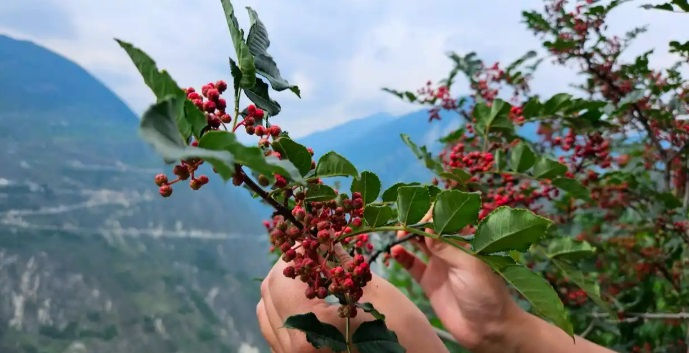
Maowen sichuan planting area
Influenced by our rigorous standards, many farmers in nearby villages have invested in Sichuan pepper (Chinese Prickly Ash) screening machines. This allows them to clearly verify compliance with quality metrics before selling, ensuring they can command higher prices for their crops.
Another key quality indicator our team prioritizes is the oil glands—the small, raised bubbles on the surface of the Sichuan pepper (Chinese Prickly Ash) pods.
Mr. Wen plucked a cluster of Sichuan pepper (Chinese Prickly Ash) from a tree, held it up to the sunlight for a close inspection, then popped one into his mouth to chew. He turned to the rest of us and offered it: “Taste this—the numbing flavor is excellent.”
I tried one, and an intense numbing sensation surged straight to my head, making my nerves tingle. I immediately reached for water to soothe the sensation.
Mr. Wen laughed: “You might not be able to tell the difference yet, but the umami and numbing notes of Sichuan pepper (Chinese Prickly Ash) are distinct—we locals can distinguish them easily.”
Mr. Wen categorizes Sichuan pepper (Chinese Prickly Ash) based on two key attributes: “numbing intensity” and “bitterness”. He explained that compared to Sichuan pepper (Chinese Prickly Ash) from other regions in China, Maowen’s variety has a milder bitter taste and a higher numbing intensity.

“If Sichuan pepper (Chinese Prickly Ash) from other areas has a numbing level of 35–40, Maowen’s will be significantly higher,” he said. This difference stems from the region’s unique geographical environment, climate, weather conditions, and altitude. For example, Sichuan pepper (Chinese Prickly Ash) grown on sun-facing slopes ( “yangshan” ) receives longer hours of sunlight, resulting in superior quality metrics compared to those grown on shaded northern slopes ( “yinshan” ).

Locals classify Maoxian’s Sichuan pepper (Chinese Prickly Ash) into varieties based on harvest time: “Dahongpao” (June harvest), July harvest, and August harvest. “Dahongpao” is the most widely cultivated variety among local farmers and a iconic product of Maoxian. Grown in remote mountain areas, “Dahongpao” Sichuan pepper (Chinese Prickly Ash) is characterized by thick flesh, pure numbing flavor, high oil content, rich aroma, and zero artificial additives.
Through countless hours of hiking and taste-testing, Deng’s Spices procurement team has selected the finest Maowen Sichuan pepper (Chinese Prickly Ash)—sourced exclusively from sun-facing slopes at 2,000–2,500 meters above sea level, in the mountains surrounding Weimen Town and Goukou Town, Maoxian County.

At Deng’s Spices, we treat the procurement of raw materials like Sichuan pepper (Chinese Prickly Ash) with the utmost care—because the quality of our Sichuan pepper (Chinese Prickly Ash) directly determines the numbing intensity and aromatic depth of our clients’ hot pot seasonings. Even before the harvest season begins, our team is dispatched to assess the year’s crop growth.
By around 5 p.m., our “mountaineering team” began descending the mountain. On the way, we encountered a local farming family—one of the area’s major Sichuan pepper (Chinese Prickly Ash) growers—busy harvesting their crop.

Harvesting Sichuan pepper (Chinese Prickly Ash) at altitudes exceeding 2,000 meters is physically demanding work. Experienced harvesters can pick 90–100 jin (45–50 kg) of fresh Sichuan pepper (Chinese Prickly Ash) per day, while slower workers manage around 60 jin (30 kg).
Mr. Wen noted that harvesters typically charge around ¥4 per jin of fresh Sichuan pepper (Chinese Prickly Ash) picked—a significant cost for farmers. A single harvester can earn ¥300–400 per day, and farmers are also responsible for their food, accommodation, and even travel expenses.
The harvest season for high-altitude Sichuan pepper (Chinese Prickly Ash) lasts for one month, and fewer people are willing to take on this physically strenuous work each year. Rising harvesting costs have become a major expense for Sichuan pepper (Chinese Prickly Ash) growers. To save costs, families often mobilize all members to join the harvest during peak season.
The mountain breeze turned gentle, and the clouds thickened, replacing the clear skies we had enjoyed earlier. A light drizzle began to fall. The air was filled with a fresh, numbing aroma that lingered on our senses. Reluctantly, we bid farewell to Maowen, bringing with us the refreshing scent of high-quality Sichuan pepper (Chinese Prickly Ash) and ending our day-long expedition in search of the world’s finest.
The highest level of craftsmanship lies in embracing simplicity. Perhaps it is precisely the extra effort invested that earns credibility in business.
Culinary Recommendations
Hot Pot & Malatang Toast the Sichuan pepper (Chinese Prickly Ash) lightly over low heat to enhance its aroma, then grind it into coarse powder and add it to the hot pot base. Its strong numbing flavor can penetrate deep into the ingredients, pairing perfectly with beef, lamb, and various mushrooms.
Sichuan Classic Dishes It is a core ingredient for iconic Sichuan dishes like Kung Pao Chicken and Mapo Tofu. Add 5–10g of crushed Sichuan pepper (Chinese Prickly Ash) during stir-frying to balance spiciness and numbing taste, creating an authentic “numbing-spicy” ( ma la ) flavor profile.
Marinades & Braised Dishes Combine whole Sichuan pepper (Chinese Prickly Ash) with star anise, cinnamon, and bay leaves to make a spice sachet for braising pork hocks, beef shanks, or duck. It can neutralize the gamey taste of meat while infusing a unique aromatic note.
Homemade Seasoning Blends Mix ground Maowen Sichuan pepper (Chinese Prickly Ash) with salt, chili powder, and Sichuan peppercorn oil to make a dipping sauce for cold noodles, dumplings, or grilled skewers.
Storage Tips Seal the Sichuan pepper (Chinese Prickly Ash) in an airtight container and store it in a cool, dry place away from direct sunlight. Avoid moisture to prevent mold and preserve its numbing aroma for up to 12 months.


Comments